
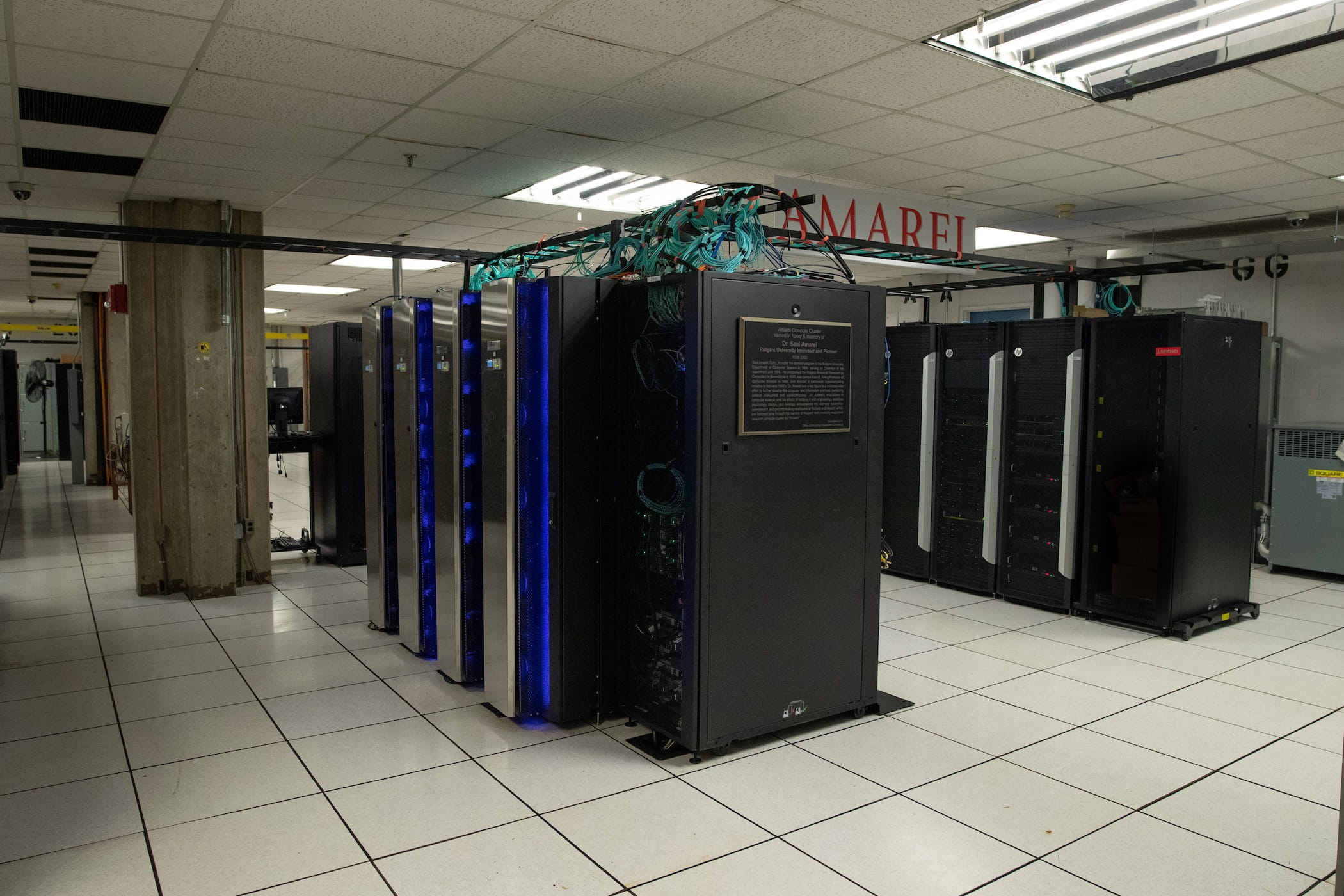
Amarel high performance computing and data
Amarel is Rutgers’ central high‑performance computing cluster, providing free access for researchers across disciplines and affordable, subsidized options for dedicated computing resources.
About Amarel
In July 2017, the Office of Advanced Research Computing (OARC) unveiled Amarel, a “condominium” style computing environment developed to serve the university’s wide-ranging research needs. The Amarel cluster provides a shared platform that optimizes resources for the benefit of all users. Named in honor of Dr. Saul Amarel, one of the founders of the Rutgers Computer Science Department and contributor to advanced computing and artificial intelligence research and methodologies, Amarel is designed to suit many different research applications.
Access to Amarel
Amarel special allocation request
Rutgers researchers may request non-standard compute or storage resources on the Amarel cluster. Special allocation requests are designed for specific, short-term needs that exceed standard usage policies, such as extended run times, dedicated compute nodes for a limited window, or additional temporary /scratch storage. The request process is restricted to Principal Investigators or designated group managers, and allocations are strictly limited—typically allowing only one large or two small requests per research group each calendar year.
This is Amarel 2017 – A Rutgers Today-produced Amarel introduction video from the inaugural year.
Facts and figures
6,000+
Rutgers students, researchers, and faculty utilizing Amarel
365+
Rutgers departments, schools, centers, and institutes performing work on Amarel
2,000,000,000+
Core compute hours since 2016
Accordion Content
Amarel hardware, ownership, and storage
-
The current phase of Amarel leading edge hardware is called Clark, continuing our tradition of naming phases after New Jersey cities. Clark doubles the compute power of a single node from 256GB per node in the past several phases to 512GB per node in Clark.
Clark compute nodes include the following:
-
-
-
- 2x Intel Xeon Gold 6538Y+ (Emerald Rapids) Processors (60MB cache, 2.20 GHz), 5600 MHz TruDDR5 memory, 32-core processors (64 cores/node)
- 16x32GB DIMMs (512GB/node)
- 960GB SSD on-board drive
- 25GigE and Infiniband NDR (200Gb/s) adapters
- The cost of node ownership is $11,435 per node
- A limited number of 3x L40S GPUs are also available at $30,755
-
-
-
-
Ownership and Access
While Amarel is available to the entire Rutgers research community through general-access allocations, investigators may also become condominium owners through a university-sponsored program. Condominium owners receive the highest scheduling priority and are guaranteed access proportional to their investment.Owner allocations are designed to provide an experience comparable to having a locally managed and dedicated research computing system, while still contributing to the broader Amarel community. When owner resources are idle, unused compute cycles are made available to the general user pool, maximizing overall system utilization.
Ownership Terms and Storage Options
Node ownership is usually based on a four-year lifecycle, aligned with the node’s fully warranted service period; however, increasing prices and limited hardware availability have recently pushed us to move into shorter terms for ownership where that makes sense. Each purchased Amarel compute node includes 1 TB of complimentary storage for the same four-year term beginning at the time of allocation. Email business@oarc.rutgers.edu if you are interested in learning more.Additional Amarel storage may be purchased to meet specific research requirements. Storage allocations are available in flexible terms ranging from one-year increments up to four-year periods that align with node ownership terms.
The Amarel storage model was recently updated as part of the Clark expansion and the newly available Research Data Storage platform, including changes to pricing and storage-term policies. For the most current information, please refer to the Amarel FAQs or email business@oarc.rutgers.edu if you are interested in learning more.
Software and Infrastructure Requirements
If you plan to use software that requires specialized licensing, configuration, authentication mechanisms, or data-transfer support, please consult with the Amarel infrastructure team before making a purchase or commitment.Software that is more complex than open-source applications installed within a user’s home directory may require a feasibility review. Some applications depend on features that are not compatible with the Amarel computing environment, including:
- Remote authentication services
- External network connectivity from compute nodes
- Persistent services such as web servers or other continuously running applications
- Specialized data-transfer mechanisms
To ensure compatibility and supportability, all software with unique infrastructure requirements should be evaluated by the infrastructure team prior to deployment.
For further information on ownership process and details, please see the Amarel FAQ.
-
Amarel owners receive 1TB complimentary storage per node purchased with matching four-year terms. Owners may also purchase additional backed-up /project storage consistent with research needs for $122.88/TB/year (price subject to change), in one- to four-year terms.
The GPFS fileset included with ownership is a subtree of a file system namespace that in many respects behaves like an independent file system and can be shared among all accounts supported by an owner. A 100GB home directory is created for each owner-supported user account. All included and purchased storage includes backup, but high-speed scratch is not backed up.
For further information on data storage usage and best practices, see the File Set section of the User Guide.
