Several IT services will be unavailable early on Sunday, Dec. 7.

Learn more
Skip to main content

Rutgers IT Annual Review

2024-2025

Measuring our mission

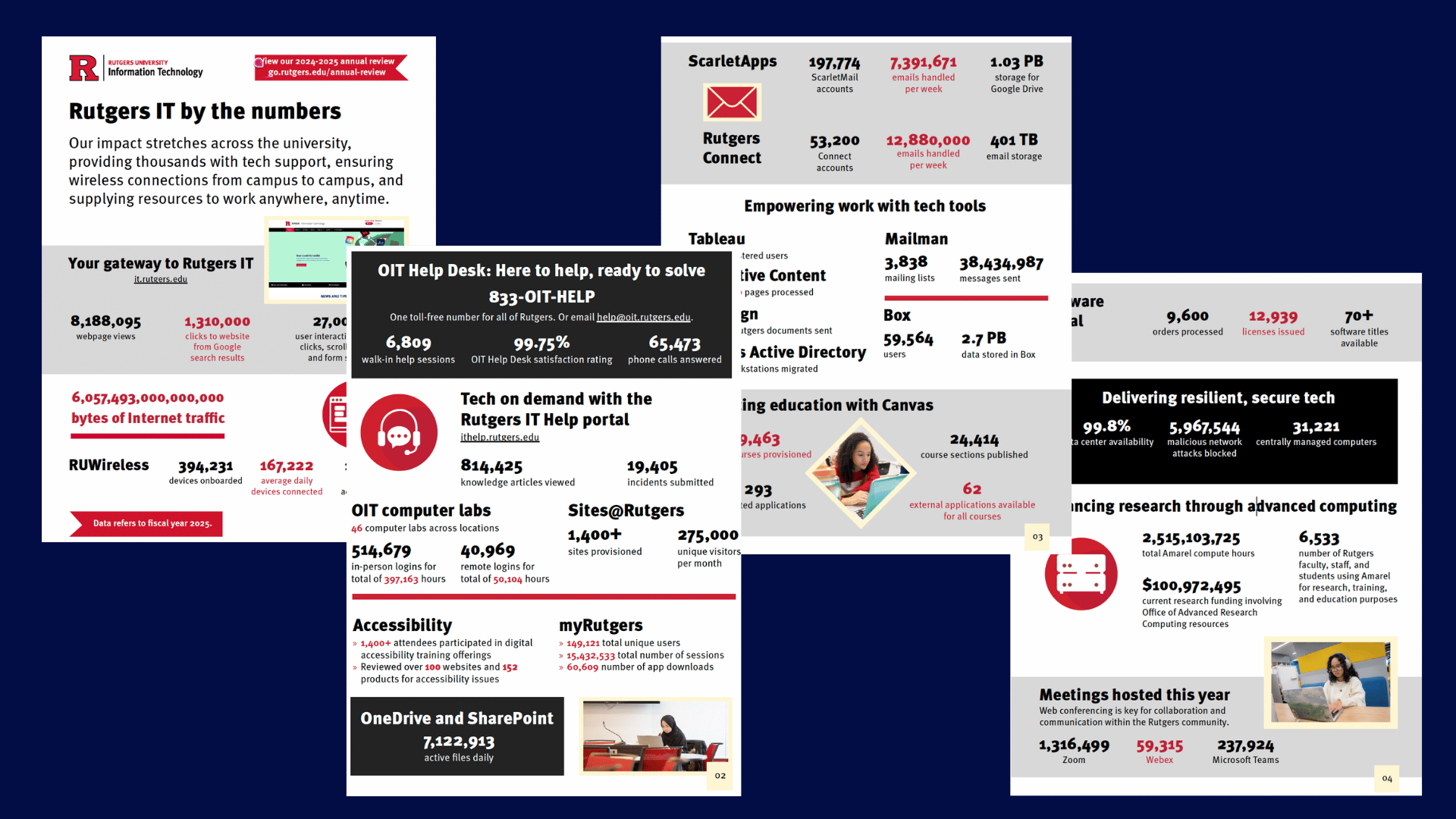
Our impact stretches across the university, providing thousands with tech support, ensuring wireless connections from campus to campus, and supplying resources to work anywhere, anytime. Explore impressive statistics, numbers, and milestones within various areas of Rutgers IT through our annual report PDF and video highlights.
Projects with purpose

Technology plays a pivotal role in shaping the university’s daily operations, and the scope of our IT initiatives is truly expansive. From rolling out touchscreen laptops in Camden to modernizing classroom attendance tracking in Newark, introducing cutting-edge services like AI tools and Research Data Storage, Rutgers IT remains at the forefront of innovation. Below, we highlight just a few of the many IT projects and initiatives that have made a significant impact at Rutgers this year.

Advancing tech access at Rutgers–Camden
col2col1

Rutgers–Camden IT has made significant strides in implementing key initiatives that reflect ongoing efforts to support a more connected, mobile, and accessible campus environment.

  • Mobile-first strategy: The transition to laptops with touchscreens is underway, reinforcing the commitment to a mobile-first approach.
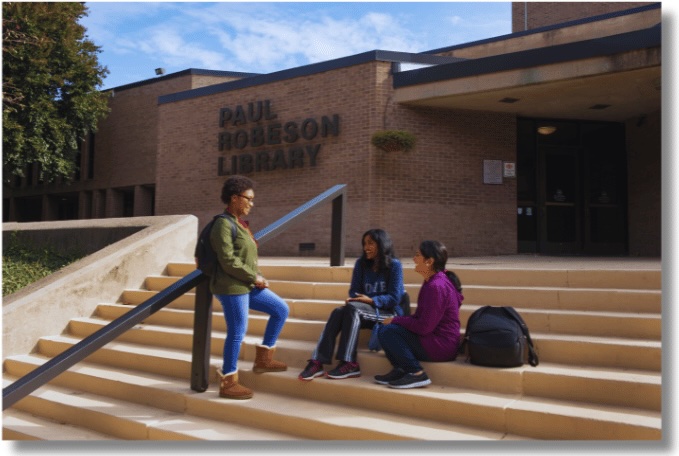
  • Laptop checkout program: Members of the Camden community can now check out laptops for up to 24 hours from the Robeson Library, providing greater flexibility for on-the-go work. While these laptops offer general software for everyone to use, they also contain specialized exam software to allow students to take exams in Nursing and Law.
  • Improved accessibility: Machine-generated captioning has been added to livestreamed campus events, making them more accessible to a wider audience.
Assessment to strengthen cybersecurity

col2col1

The university worked with an external firm, Stratascale, to conduct a major cybersecurity maturity assessment at Rutgers, reviewing existing cybersecurity controls and practices and determining areas for improvement. Results are being used to guide future cybersecurity initiatives and protect Rutgers systems and data.

Clinical and Research Data Warehouse building momentum

col2col1

The Rutgers Clinical and Research Data Warehouse, a central repository unifying diverse healthcare data sources and housing healthcare-aligned data, has undergone substantial growth and increased project flow since it was announced in January 2024. Over the past year, improvements have been made to refine processes, shorten production time for researchers, refresh computational components, add high-performance and GPU capabilities, assess security, and unify the fee structure. Through June 2025, over 150 Rutgers researchers partnered with a CRDW team member to assist with their research projects. Additionally, many CRDW-related presentations were conducted for research deans and faculty, as well as IT professionals, since the launch.

Cyber safe. Rutgers strong.

The Information Security Office (ISO) continued its efforts to educate the Rutgers community on cybersecurity and cyber threats in FY 2025. As a result, Gramm-Leach-Bliley Act (GLBA) and Payment Card Industry Data Security Standard (PCI-DSS) compliance training concluded with 93% and 87% completion rates, a 3% increase over the prior year. Meanwhile, more than 1,300 Rutgers employees completed recommended security training through KnowBe4 during FY2025. The ISO looks forward to expanding the KnowBe4 training effort in 2026. Additionally, the ISO collaborated with the Big Ten Academic Alliance (BTAA) and the National Cybersecurity Alliance (NCA) for National Cybersecurity Awareness Month events. Learn more about the general and customized training opportunities offered by ISO.

Expanding faculty research capabilities with REDCap survey tool

col2col1

The REDCap research survey tool, now striving to move to a centralized instance under OIT, allows university faculty to expand their research capabilities. Through FY25, the platform has supported approximately 1,750 users and 750 projects. The New Jersey Medical School (NJMS) is the first group partnering with OIT to move its substantial existing REDCap instance into the central instance, with additional instances planned soon thereafter.

Leveling up the OIT Computer Labs
col2col1

Computer lab upgrades were made across all campuses over the past year, including:

  • New Brunswick: Workstation replacements in the Library of Science and Medicine, Allison Road Classroom Building, Carr Library, and the Rutgers Academic Building.
  • Camden: Upgraded laptops in the Campus Center and Business and Science Building.
  • Newark: Replacement of fifty workstations across multiple buildings.
  • Additionally, updates to the overall computer lab system were made to accommodate the latest academic and productivity software.

Meet your new writing assistant, Grammarly for Education

col2col1

Grammarly for Education was made available to the university community in September 2024. The tool provides faculty, staff, and students with:

  • real-time vocabulary suggestions
  • genre-specific style checks
  • tone recommendations
  • plagiarism detection
  • grammar review
  • citation assistance
  • AI prompts that suggest improvements
Modernizing Rutgers Health IT infrastructure and enhancing the student experience
col2col1

Continuing its mission to align technology, health, and academic priorities, Rutgers Health IT teams successfully completed 35 projects to modernize IT infrastructure and 22 projects to enhance the student experience. These efforts collectively advanced digital transformation, operational efficiency, and academic engagement across the university. Key accomplishments include:  

  • Continued progress toward completing the RAD Migration initiative and upgrading to Windows 11, both of which strengthen data security and system performance.
  • Wi-Fi upgrades, desktop and device refresh initiatives, and enhancements to the printing environment that promote sustainability and efficiency.
  • Implementation of new digital communication tools—including SimpleTexting and Five9 Call Center systems at the New Jersey Medical School and School of Dental Medicine, along with MappedIn indoor wayfinding at the New Jersey Medical School.
  • Extensive AV upgrades at the School of Health Professions, New Jersey Medical School, School of Public Health, School of Nursing, Ernest Mario School of Pharmacy, Robert Wood Johnson Medical School, and the Institute for Health, Health Care Policy, and Aging Research, enhancing instruction, campus engagement, and learning with interactive tools and modern classroom technology.
New Clinical Informatics microcredential available to Rutgers Health community
col2col1

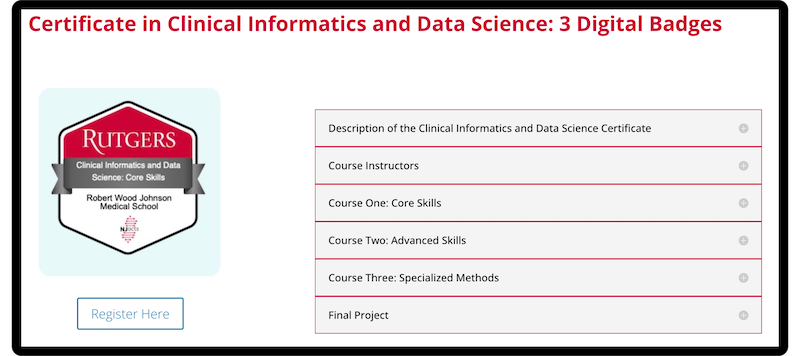
The New Jersey Alliance for Clinical and Translational Science (NJ ACTS) and the Rutgers Institute for Translational Medicine and Science (RITMS) partnered with the Office of Advanced Research Computing (OARC) to launch a microcredential in Clinical Informatics and Data Science. At no charge to students, this microcredential is designed for medical students, doctors, or researchers with experience in the fundamentals of R and Python, enabling them to quickly and efficiently analyze patient data and inform clinical decisions.

New Jersey grants support building the network of the future

col2col1

A fast, secure, and efficient wireless network is essential to effective teaching, learning, and research. Using funding from the state’s Higher Education Equipment Leasing Fund (ELF Grant), Rutgers installed 12,550 new Juniper Mist access points in 2024-2025, introducing the latest generation Wi-Fi frequency band. By using the Higher Education Technology Infrastructure Fund (HETI grant), network teams replaced outdated, end-of-life network switches in 2024-2025 and will continue these upgrades during FY 2026. These projects allow both wired and wireless networks to integrate AI capabilities that proactively monitor network performance, providing increased uptime, better service, and enhanced support.

New look for Rutgers Automated Mass-mailing System
col2col1

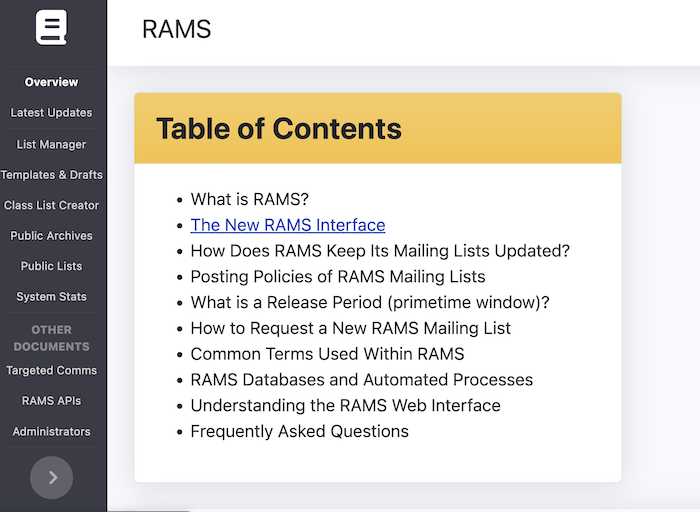
The Enterprise Messaging and Collaboration Services team launched a new interface for the Rutgers Automated Mass Mailing System (RAMS), a major system for targeted email lists that are essential for internal communications at Rutgers. The modern, mobile-friendly interface offers improved response times and a more simplified, organized layout. The old RAMS web interface was decommissioned, and new features will continue to roll out over time.

New university-wide Student Information System preparing for 2026 takeoff
col2col1

The Student Experience Improvement Initiative (SEII) continues to advance the university’s dedication to providing seamless, integrated, consistent, effective, and responsive services that meet the needs of Rutgers students. A major part of the SEII initiative is the implementation of a single university-wide student information system (SIS) within the Oracle Cloud Enterprise. Since early 2025, the Enterprise Applications and Research Computing team has been working closely with the system implementer, Sierra Cedar, to assess, review, and set up the technical and system environments needed for this project's kickoff in 2026. Additionally, next year, an extensive business process review will be prepared for the future state design and implementation of the Oracle Student Management Cloud.

OIT pilots Research Data Storage program for research labs
col2col1

Need a reliable place to store your research data? Research Data Storage (RDS) offers research labs and university centers 34 PB of total usable space for research data, designed to ensure reliable access to university research data. RDS is a collaborative effort managed and maintained by OIT’s Office of Advanced Research Computing and Enterprise Infrastructure. RDS had been in a pilot phase for several months before becoming available to the university community in late 2025.

Preparing for an AI-influenced world

Artificial Intelligence remains a hot topic across higher education, presenting fundamental shifts in how we work and learn. As Rutgers explores this emerging technology, the Office of Information Technology made the Microsoft Copilot chatbot, Google Gemini, NotebookLM, and more AI-integrated tools available to the university community during FY 2025. These Rutgers-approved tools have additional security and privacy safeguards that protect university data, and should be the go-to options for using AI at the university. Meanwhile, pilot efforts tied to the AI@Rutgers Initiative continue to explore new AI tools for possible implementation at Rutgers.

Rutgers–Newark pilots new classroom attendance technology
col2col1

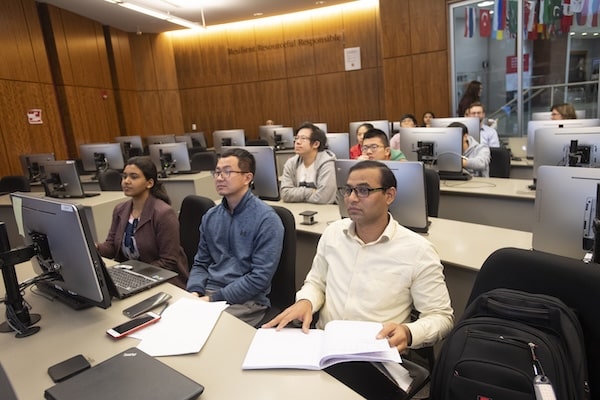
Rutgers University–Newark has been piloting an academic technology initiative since the beginning of 2025 to modernize classroom attendance tracking by offering faculty and students multiple options based on their needs and class sizes. The system includes traditional roll call, QR code scanning, location-based app check-ins, and student ID swipes, allowing instructors to select the most effective attendance method for each course. Research consistently shows that tracking and acting on attendance data improves student outcomes, particularly in fostering engagement and supporting retention. This initiative has reduced administrative overhead, increased accuracy, and generated valuable data to strengthen early alert and student success strategies. Faculty and student feedback from the pilot are now shaping the next implementation phase.

Shaping the future of AI at Rutgers
col2col1

More than 100 faculty members, researchers, technologists, and other experts have played key roles in the AI@Rutgers Initiative—an effort to shape how Rutgers uses artificial intelligence across academic, clinical, research, technology, and administrative areas. By coordinating and consolidating guidance from multiple stakeholders, the group is developing a strategic framework to prepare students, faculty, and staff to use AI securely, ethically and responsibly. Their work has included information gathering about existing AI projects, benchmarking against peer institutions, and assessing risks and opportunities. Their efforts are setting the stage for recommendations to guide the future of AI at Rutgers.

Message from Michele Norin, Senior VP & Chief Information Officer

In my years in technology, I’ve rarely seen anything reshape our world as quickly—and as profoundly—as artificial intelligence. AI is everywhere now, from predictive text in your email to AI features built into tools like Adobe Creative Cloud and Zoom. Across higher education, AI is prompting fundamental questions about how we teach, learn, and conduct research—and how we can use these tools wisely and responsibly.

At Rutgers, we’re approaching these changes with both excitement and care. We want to empower innovation and, at the same time, ensure our use of AI reflects the university’s values. That means listening, collaborating, and learning together as we navigate what’s next. I encourage you to explore the tools available, review our initial guidance for AI, and stay updated on the AI@Rutgers Initiative—an effort bringing together more than 100 faculty, technologists, researchers, and others to develop a strategic framework for AI at Rutgers.

As with AI, our broader technology efforts are focused on enabling the extraordinary work of our faculty, students, researchers, and staff. I’m deeply proud of the IT professionals from across Rutgers who make that possible every day—building, supporting, and securing the university’s technology ecosystem. Together, we’re helping Rutgers not just adapt to change, but lead through it.

Sincerely,

Michele Norin Signature
Michele Norin
Senior Vice President

What's new with Rutgers IT news

For more information on what’s going on within Rutgers IT, visit the Rutgers IT newsroom for important announcements, tech updates, staff spotlights, and more.

Annual Reviews archive
The annual review highlights the wide variety of areas IT touches at Rutgers, such as high-performance computing, educational technology, web conferencing, and more. <span>The review includes impressive data and charts and highlights various IT projects and initiatives that advanced the university’s missions of teaching, research, service, and healthcare.</span>

Inside look at Rutgers IT resources

Learn about Rutgers IT and the wide variety of resources offered to faculty, staff, and students, including the Rutgers IT newsroom, Tech Guides, security tips, web conferencing best practices, and more.

Annual review 2024-2025 credits

  • Produced by the IT Communications team within the Office of Information Technology
  • Communications planning, creative direction, and project management by Amanda Pecora-DeFazio
  • Writing and research by Allan Hoffman, Amanda Pecora-DeFazio, Tori Yeasky, and Eileen Oldfield.
  • Website development by Rich Sese
  • Website design and coordination by Anita DeSimone
  • Graphic design by Kyndall Thornton
  • Also, thank you to the numerous IT staff members throughout various OIT divisions and Rutgers schools, departments, and units who provided statistics and data for the 2024-2025 annual review.

Data refers to fiscal year 2025, unless otherwise noted.