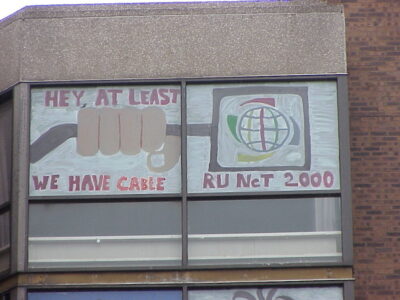
Twenty-five years ago, at a pivotal moment in technological progress, Rutgers set in motion one of the largest infrastructure initiatives in university history: The RUNet 2000 project. Following years of strategic planning and collaboration, this project delivered an integrated data, video, and voice network that would propel Rutgers into the future and lay the foundation for the university’s infrastructure as we know it today.
RUNet 2000 came to fruition in the late 90s under the leadership of former Rutgers president Francis Lawrence. At the time, network infrastructure was expanding rapidly across universities, and it became a clear priority for Rutgers to achieve improved infrastructure.
Prior to the project, it is estimated that just half of Rutgers faculty and staff, and one-third of students, had internet connectivity. The completion of RUNet 2000 saw these rates rise to nearly 100% as all three locations—New Brunswick, Newark, and Camden—reaching levels of network connectivity never seen before.
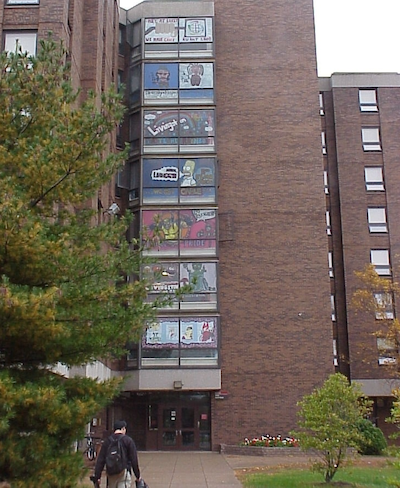
This required efforts across departments, units, and outside partners, as well as a budget of $100 million to be allocated over the course of five years. The geography and size of Rutgers posed unique challenges that would call for 64 miles of underground conduit across campuses, wiring installation spanning hundreds of buildings, cabling across the Raritan River, and even a 20-minute shutdown of Newark Liberty International Airport for aerial mapping of the area.
“We were tasked with expanding infrastructure in areas never initially designed for it, calling for creative solutions and meticulous planning,” said Michael Storer, a director of telecommunications for the Office of Information Technology (OIT) and former manager of construction on RUNet 2000. “We were challenged every step of the way—whether it was obtaining rights of way to dig, gaining individual approvals from departments for wiring closets, or utilizing software new to the university.”
Throughout the extensive construction of the project, 260 buildings had to be internally wired, and over 500 residential, academic, and administrative buildings required the addition of telecommunications closets and equipment rooms. There was no previous network infrastructure in housing spaces, and many buildings only had connectivity via dial-up modems.
By the end of the project, a robust and expanded network infrastructure was achieved—the Rutgers community now had seamless access to the internet, advanced voice capabilities, and even a new university-wide cable television network, RU-TV. This enhanced connectivity was not only critical at the time, but would continue to serve the university for years into the future.
Fast forward to today, where internet connectivity and network infrastructure are at the core of everyday life
and operations at Rutgers. More than 1,100 buildings and 31 million square feet of real estate are now covered by the Rutgers network, which serves more than 50,000 wired devices and almost 110,000 wireless devices daily.
While RUNet 2000 paved the way for the university’s next era of digital improvement, most technologies driving current network demands did not exist at the time, such as smartphones, tablets, and wireless connections. This shift has led to innovation through the lens of a new massive infrastructure project: The Next-Gen Network.
Rutgers’ Next-Gen Network is the university’s latest major network effort, focused on achieving a faster, more resilient network while expanding wireless connectivity and support for next-generation innovation. At the time of RUNet 2000, no one predicted how quickly the shift to wireless connection would take place, yet now just about everything is on Wi-Fi.
Funding has been targeted for project priorities, including expanding wireless coverage for areas that are highly deficient, increasing network speed and capacity,
and enhancing critical pathways to ensure network resiliency. By upgrading key infrastructures and boosting connectivity, the project aims to provide a seamless, high-performance network experience for the entire Rutgers community, addressing both current demands and future technological advancements.
Since the project’s approval in 2020, teams involved with the effort have been working diligently to deploy critical enhancements to the network to achieve a network
core that is 10 times faster than previously established.
Additionally, the Next-Gen Network project has received multiple state grants. The grants are funding upgrades of over 450 network switches at Rutgers, replacing end-of-life devices using external power adapters with power-over-ethernet devices, and replacing all wireless access points at the university with new high-speed devices. End-of-life emergency blue light phones across campuses have also been replaced with 295 newly installed blue light phones.
Residence halls at Rutgers are receiving major upgrades through a partnership between OIT and Institutional Planning and Operations. The project is bringing considerably faster networking and Wi-Fi to every residence hall in New Brunswick, Newark, and Camden, and upgrades are underway in 73 buildings to date.
As Rutgers continues to advance its technological infrastructure, the legacy of RUNet 2000 and the ongoing evolution of the Next-Gen Network showcase the university’s dedication to meeting the ever-changing demands of digital connectivity. The successful completion of RUNet 2000 set a high standard, and the Next-Gen Network builds on that foundation with a forward-looking approach, addressing current needs, future requirements, and possibilities.
This ongoing dedication keeps Rutgers at the cutting edge of higher education technology, improving experiences for everyone on campus and setting the stage for future innovation and growth.
Tags: Camden, IT community, network, New Brunswick, Newark, project management, ResNet, RUWireless, video, Wi-Fi